BSP


Kanji Learning Today: Online 1 Introduction
Coverage of this Introduction
Go to Online 1 Table of Contents
General Introduction
The following general introduction pertains to the entire Kanji Learning Today series, which includes the Online volumes and the Workbooks.
For Whom this Series Is Meant
This series is meant for people who are serious about learning kanji so that they can become readers of the Japanese language. Reading at a level that is on par with the average Japanese adult requires understanding of the entire Joyo Kanji List (常用漢字一覧), which includes 2136 characters. A person can ponder which few can be set aside as less important, but the vast majority are needed for functional literacy.
For the person learning Japanese as a second language, this is a daunting challenge. The Kanji Learning Today series, including Volumes 1, 2 and 3 as well as the corresponding Workbooks, employs unique methods to cover all of the kanji and help the learner attain a reading level.
For Whom this Series Is Not Meant
This series may not be suitable for a learner who merely wants a basic introduction to kanji. Such a person may be interested in a limited list of critical characters but does not want to push toward full literacy.
Coverage of the Volumes
The coverage of each volume (and corresponding Workbook) is explained below.
Kanji Learning Today 1: The Education Kanji
Online 1 covers the 1026 “Education Kanji” (教育漢字). The Ministry of Education specifies that these characters be taught at the Japanese elementary school level. Furthermore, the Ministry assigns particular kanji for instruction at particular grades, ensuring that children learn in an incremental and supportive way, building a reading level as they go. Kanji Learning Today follows the same grade levels, referring to them as “Years” (school years), thereby helping the second language learner develop reading ability with the same structure.
Kanji Learning Today 2: The Graduation Kanji
Online 2 presents the 1110 “Graduation Kanji”, a term selected by the editor. The Ministry of Education says these characters will be taught in middle school and high school but does not mandate which characters be taught at a particular grade. The volume, along with the Education Kanji, completes the Joyo Kanji List, which forms a baseline for literacy and circumscribes the characters allowed in official government documents.
For convenience and learning efficiency, the editor has separated these kanji into Years 7 through 12, with a quantity of kanji in each Year made similar to the quantities taught in each grade of elementary school. The editor assigned kanji to each year based on two factors: importance and element grouping. In general, important and frequently used characters appear in the earlier Years, such as 7 and 8, while the less frequently used characters appear later, such as Year 12.
Regarding element grouping, many characters in Online 2 are placed in a particular Year in order that similar characters will be near each other. Such characters have an element in common, and often a reading in common, so placing the characters near each other helps the second language learner identify the appearance of elements as a way to determine a likely reading. For example, in Year 9 the characters 洞 and 胴 are next to each other, and each has the on reading “どう”, whereby the learner can see that the held-in-common right side element in the characters is associated with the どう reading and therefore may posit that an encountered unfamiliar kanji incorporating the same element may have the same on reading.
Kanji Learning Today 3: The Name Kanji
Online 3 offers the 864 “Name Kanji” (人名用漢字). These are characters not on the Joyo Kanji List but were deemed important to be allowed to be used in the official registration of people’s names, and are for that reason approved for name use by the Ministry of Justice. For clarity’s sake, it should also be noted that the Joyo Kanji can also be used in people’s names.
Even though the list is specifically intended to allow use of the kanji in names, it sometimes seems as a “backdoor Joyo List” because many of the characters appear frequently in literature and other documents. In fact, nearly two hundred Jinmei characters were transferred to the Joyo List in 2010.
As with Online 2, the editor assigned important kanji to earlier Years (Year 13 and 14), and less frequently used to a later year. However, these are not grouped by element as in Online 2. Years 13~15 present unique kanji, while Year 16 presents variants of Joyo kanji that the Ministry of Justice approves for use in names.
Online Introduction
The following information pertains specifically to the Online volumes and certain features may not apply to the Workbooks.
Study kanji on a phone, tablet, or computer.

Each page is interactive — tap to study.
Structure of the System
A “Year” in Kanji Learning Today is equivalent to a “grade” in the Japanese school system. Each Year has a total amount of kanji to be learned, such as 80 kanji for Year 1.
There are Years 1~6 in Kanji Learning Today: Online 1 and Years 7~12 in Kanji Learning Today: Online 2 form a total of 12 Years that cover the 2136 kanji given in the Joyo Kanji List (Common Use List). The Years 13~16 in Kanji Learning Today: Online 3 cover the 864 kanji of the Jinmeiyo Kanji List (Name Use Kanji List).
A “Set” is a group of 20 kanji from within the total for a Year. This allows a workable amount of kanji for an Online page, and it fits well on a Workbook page.
The total amount of kanji for the Year are presented in Go-Ju On order, which is the alphabetical order of the Japanese language. Because each Set gives 20 kanji, the kanji of the set are in Go-Ju On order and the flow from one set to another set continues the Go-Ju On order.
Types of Pages
The five types of pages for learning kanji are as follows.
In addition, after the user thinks he or she can remember all the readings of a Year, there is another type.
The Reading page gives the readings (pronunciation) of each kanji. The listed readings are those approved by the Ministry of Education for use in public documents; therefore, these are the most important readings for the given kanji.
The Special page gives the readings for each kanji. Many of these special readings are important and widely used, but they do not have that important stamp of approval by the Ministry of Education. Other readings in the Special page may not be widely used.
The Example page gives two example words for each kanji. Most words that include kanji also include additional characters.
The Description page presents an explanation of the visual pictographic structure for each kanji, if there is such a pictograph. This can help in remembering the meaning of the kanji.
The Memory page lists the kanji and its okurigana (if any) but allows the user to attempt to visualize the reading before tapping and revealing the reading.
The Test pages present all of the kanji for the Year, but in random order. The user again chooses between the two given options.
Reason for Multiple Choice in Readings Pages
The Readings pages are considered the most important for learning the kanji characters. These are the pages the user should use most. By frequent practice of the pages, the user should recognize many kanji within a relatively short amount of time.
The reason for giving the readings of each kanji in a multiple choice fashion is to speed up the practice process and make it more enjoyable.
When the user is faced with a choice between two readings and must choose which is correct, the user has at least a 50% chance of being correct, even when encountering the information for the first time.
Most users will find that their chances soon become much better than 50%. After some experience, patterns start to come into play, and the user can intuitively lean toward a particular answer. That intuition will often be correct.
Once a user has practiced the Reading pages several times, the ability to recognize encountered readings combines with the ability to intuit correct answers and the scores get better and better.
In comparison, when no multiple choice readings are present, the user may become lost and discouraged when trying to think of what the correct readings may be.
In fact, that experience can be provided by going to the Memory pages. Those pages challenge the user to visualize the correct reading before tapping the Presentation cell to reveal the reading. For users with much experience, this is a reasonable way to build stronger confidence that he or she remembers the readings accurately, but for a new user it may result in a great amount of frustration.
As mentioned above, the process of selecting a multiple choice answer is also enjoyable. The user gets a hint, one answer or the other will be right, and gets to find out if he or she has guessed correctly.
It is also fast. A user can quickly tap an answer, digest whether he or she was correct or not, make a mental note about the reading in order to remember it, and move on to the next reading within a second. Moving down the entire page at a somewhat rapid clip becomes possible.
The entire process furthers the Kanji Learning Today goal of practicing many kanji many times. Recognition of many kanji soon develops in the user.
Getting Started
Start with the Reading page for each Set. The most important goal of the user is to learn the readings.
A new learner may not have a clue about which of the two reading options is correct. In that case, just guess and see which one is right. The next time you practice the same set you will have the chance to see if you remember.
Go through the entire set somewhat quickly, and move onto the next set. Many users will be able to cover three or four sets in less than half an hour.
The more times you review the sets, the faster you will learn all the kanji.
After starting with the Reading pages, the user may want to start checking the Special, Example, and Description pages. The information can help with overall understanding of the kanji.
Proceed Quickly
The Japanese language uses a lot of kanji. So the new learner needs to study a lot of them. There is no time to waste.
Proceed through each Year quickly, then practice the Year again.
When the kanji of the target Year are familiar, go to the next Year. Go through that Year quickly and then review all previously studied Years.
Keep it up. Go forward to the next higher Years, and go back to review. Soon you will remember enough kanji to read many things in Japanese.
Tracking Progress
The Online system does not include an automatic tracking function. If you want to track which sets you have completed, you have the option of downloading and using the following form.
The Test Pages
The Test pages for a given Year present all the kanji of that Year. They quiz the learner on all the readings of each kanji as given in the Readings page (the Joyo Regular and Joyo Narrow readings).
But the Test pages add to the challenge by presenting the kanji of the Year in random order. The user must truly recognize the readings.
The total score for each set is not recorded, so use the corresponding KLT Tracking form to keep track. The Tracking Form is referenced on the Test pages.
Example Page Symbols
The following symbol is used in the Example pages.
≠ indicates “not equal to”, in relation to a given reading. The word is not equal to only this reading and in fact has more than one reading. An example: 昨日 has the reading きのう and the reading さくじつ.
Description Page Symbols
The following symbols are used in the Description pages.
| indicates that the same radical has a “~hen” version, which is a variant of the radical at the left-hand side of the character. An example: 牛 (うし|、cow) has a variant called うしへん, which happens to have the form 牜.
— indicates that the same radical has a “~kanmuri” version, which is a variant of the radical at the top of the character. An example: 竹 (たけ —、bamboo) has a variant called たけかんむり, as shown in the character 笛.
E indicates an element. This means that the form is used as a constituent of a full character, but the form is not used to index characters, as is a radical. An example: 央 (おう、center; E).
邦 (おおざと、large village: alt of 邑、むら) is a variant that appears at the right of a character. The form consists of only the upright section at the right half, but this character with unrelated strokes is shown for convenience in presentation.
阡 (こざとへん、small village: alt of 阜、ふ、hill) is a variant that appears at the left of a character. The form consists of only the upright section at the left half, but this character with unrelated strokes is shown for convenience in presentation.
关、はちがしら is a variant of ハ (はち、eight) that appears at the top of a character. The form consists of only the two strokes at top, but this character with unrelated strokes is shown for convenience in presentation.
尚 (なおがしら、ツ、small: alt of 小) is a variant that appears at the top of a character. The same is true for 畄(ツ). The form consists of only the three strokes at top, but this character with unrelated strokes is shown for convenience in presentation.
Acknowledgements
Kanji Learning Today was developed by Todd Adkisson. Thanks to Marty Crouch for developing code used in the online volumes.
Workbook Introduction
The Kanji Learning Today system includes three workbooks.
Writing the kanji boosts recognition.

Each Workbook presents the kanji with the same sequence as the corresponding Online volume. The reinforcing effect helps the user learn faster.
The workbook pages are printed on thicker-than-standard paper for easy writing.
Within the workbook, each Practice Page is accompanied by a Stroke Order Page so that the user can quickly glance at a diagram to note the correct stroke order for writing a particular kanji.

In the workbook, each Practice page on the right is accompanied by a Stroke Order page on the left so that the user can quickly glance at a diagram to note the correct stroke order for writing a particular kanji.
Another feature of the workbooks is the appearance of “kanji-in-kanji” entries for many kanji.

When the kanji being studied includes another kanji within its structure, the entry shows the other kanji and gives its location within the Kanji Learning Today system.
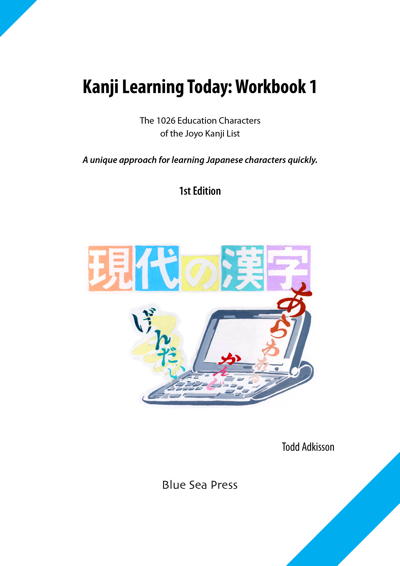
Kanji Learning Today: Workbook 1
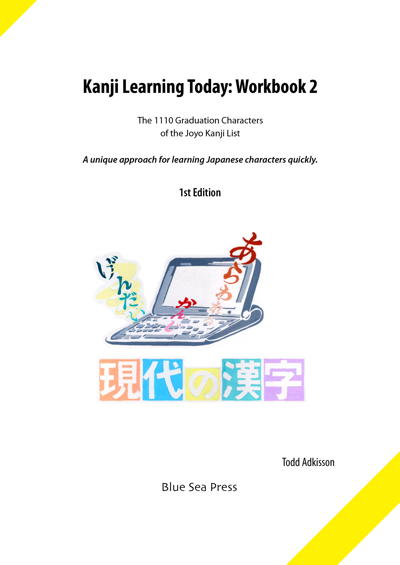
Kanji Learning Today: Workbook 2
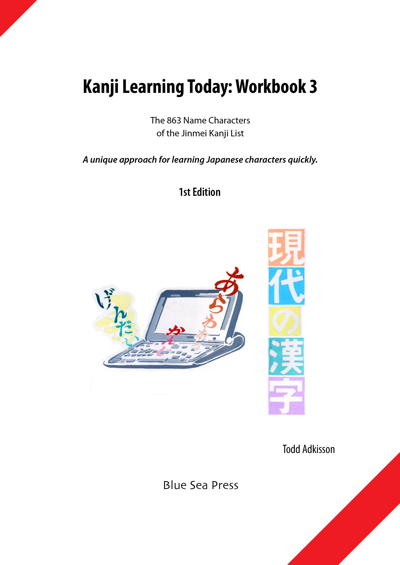
Kanji Learning Today: Workbook 3
Recognition of Kanji is the Goal
The main goal of implementing Kanji Learning Today is to recognize the kanji. This means to identify a particular kanji as having already been encountered, remember what its readings are, and recall the basic meaning of the character as it is used in the word in which it appears. This task is deployed across all the kanji of the volumes.
Reading of information, in documents, on screens and in other media, is based on recognition. The second language learner needs to recognize every kanji in a sentence, or at least recognize most of them and be able to consult a dictionary for the rest.
Kanji Learning Today builds the recognition faculty by presenting kanji in quantities that the learner can absorb while motivating the user to move forward through the volumes and thereby add more kanji.
Furthermore, when writing the Japanese language with the assistance of a device such as a computer or phone, the reading (syllabic pronunciation) of the kanji is entered to the input device and a choice of options appears to allow the desired kanji to be selected. This, of course, requires the person to remember the reading during input and to recognize the desired kanji from among the options.
In this way, the goal during both reading and writing of Japanese becomes recognition of the kanji.
Contrast this with a kanji learning approach that has the goal of learning to handwrite the kanji from memory. Much more effort is needed to remember the desired character, every stroke in the character, and the stroke order for writing the character.
The Workbooks promote writing of the kanji, and doing so with correct stroke order, but the purpose is to promote recognition of the characters. A secondary result is that the learner may be able to properly write many of the kanji from memory.
Shifting the goal of kanji learning to recognition allows the student to more quickly attain functional literacy.
Concept
The Kanji Learning Today method stresses that the user should review many characters, many times. The process for learning kanji needs to be efficient because there are many characters to learn. Kanji Learning Today allows the learner to encounter hundreds of kanji within the first few weeks of use. The user will have seen more than a thousand kanji by completing Workbook 1 and another thousand by completing Workbook 2. This helps build functional literacy in the Japanese language.
Compare Kanji Learning Today with a method that presents a few kanji per day as the learning goal. With such a method the learner will not progress fast enough to gain new kanji while retaining the formerly learned kanji. The result with other methods is that the user never learns enough kanji to become literate.
Building a Reading Level
In addition, Kanji Learning Today focuses on helping the user build a reading level from the very beginning. When Year 1 kanji have been learned, books written for Japanese first graders become a reasonable reading target. This provides incentive to complete Year 2 and move all way through Year 6. Books written for adolescents suddenly become a source for vocabulary building and language learning.
The same is true for Workbook 2. More important and frequently used kanji appear in lower numbered Years. By advancing from Year 7 to Year 12, the learner progressively builds functional reading ability.
The “Year” Increment
Kanji Learning Today separates the kanji into “Years” that are meant to be equivalent to grade levels in a school system. In Workbook 1, the correspondence is exact, mirroring grades one through six in Japanese elementary schools. In Workbook 2 the Years have been selected by the editor while maintaining a quantity in the neighborhood of two hundred characters per Year, as was done by the Ministry of Education with the elementary school kanji. Workbook 3 is like Workbook 2. When a learner has become familiar with the kanji for a Year, he or she is ready to engage subject matter written for that level.
Progressing and Reviewing
There are many kanji in the Kanji Learning Today volumes, and it will take a lot of practice to recognize all of them. The user will benefit from moving forward and then going back to review.
For example, a new learner would start a Year 1 and practice all the kanji. The recommended method is to write each kanji one time (or tap the Online information for each kanji one time), proceeding quickly in order to complete all the kanji of the Year. With Year 1, that would be a total of 80 kanji that were practiced.
It is very likely that the new learner will not recognize all of the 80 kanji and remember all of the associated readings after just one practice session. Therefore, the learner goes back to the beginning of Year 1 and executes a second practice session. At this point, two of the practice squares for each kanji in Year 1 have been filled.
A third and fourth practice session for Year 1 will likely be needed, but by this time the user may be recognizing quite a few of the 80 kanji and feel like a new challenge is in order, so the user proceeds to Year 2 and progresses through it until completed. Now the learner has been exposed to 160 more kanji, those of Year 2, and may be feeling a little overwhelmed.
The user then returns to Year 1 for a review session, and it is likely that the user will be surprised at how many Year 1 kanji can now be recognized, in comparison with the new characters seen in Year 2.
This leads to a pattern of going forward for exposure to new characters and going back to earlier Years for review sessions.
Example of Progress and Review Pattern
The pattern and pace for progress and review will differ for each user, but the following is an example of the pattern.
With this type of pattern using the Workbook, the practice squares in earlier Years will fill faster than the squares in later Years. The user may need to adjust for this as explained in the “Additional Practice When Squares Have Been Filled” section below. Use of the Online volumes will not incur a problem with filled space, but the concept of progressing and reviewing still applies.
However, eventually the user will find that the kanji of the earlier Years have become easily recognizable and do not need practice as often as later Years. This means that an equilibrium will eventually be reached and all the Years can be reviewed at approximately the same frequency.
Use of the Online volumes will not incur a problem with filled space, but the concept of progressing and reviewing still applies.
Practice Pages and “Sets”
The Practice Page is the central feature of the Kanji Learning Today workbook. The page allows the user to write each kanji, thereby helping ingrain it in memory.
Each Practice Page page is called a “Set” and has a number in the top right corner to identify it, such as 1年1セット (ichi nen ichi setto, “Year 1, Set 1”).
The Set presents a group of 20 kanji characters. Essential information is given for each character, allowing the student to review the information related to the character and then write the character.
The student should write each character only one time during a given review session. While it is important for the user to make an effort to learn about each character, it is also important for the student to quickly move to the next character. Doing so allows review of all 20 characters within a matter of minutes.
Go-Juu On
The kanji are presented in Go-Juu On order (“The Fifty Sounds”). This is the normal order of the Japanese syllabary, as seen in the order of the hiragana characters (あ、い、う、え、お。 か、き、く、け、こ。 etc.).
The ordering by Go-Juu On applies to each Year as a whole. Therefore the characters in each Set will be in Go-Juu On, with the sequence picking up from the prior set and continuing in the next set.
Readings
Readings are given in hiragana in order to facilitate proper pronunciation. “On” readings (Chinese-derived pronunciations) are presented in the upper section of the Readings box. “Kun” readings (derived from native Japanese words) are presented in the lower section of the Readings box. In the Workbooks, an asterisk (*) in the Readings box indicates that there exists one or more important readings that could not fit into the cell. A bullet (・) indicates that the reading is not seen frequently. A sharp (#) indicates that a reading is a Joyo anomaly or is not acknowledged by the Joyo List but is important.
Stroke Order
See the Stroke Order Pages in the Workbooks for illustrations of character writing sequence. The principles of stroke order are basically top-to-bottom and left-to-right, but it can help to see the illustration for a specific kanji, especially with a complex character.
The paperback version places each Stroke Order Page directly opposite the Practice Page so that the user can quickly consult the diagrams.
The Workbooks have 16 cells available to illustrate stroke order, so characters with more than 16 strokes omit at some point one or more strokes and an asterisk (*) is given in the cell directly after a skipped stroke. The stroke order for an omitted stroke should be obvious to a user who has practiced earlier sets.
In addition, in Workbook 3, an ampersand (&) is given when a stroke order diagram was not available and that of a variant was used in its place.
Accent
The entry for each kanji in a Practice Page of the Workbook shows the accent for a word by presenting the accented syllable in bold font. Additionally, the okurigana are shown with an underline.
The main principle of accent is that the penult (one syllable forward of the last syllable in the word) is accented. This is shown only for kun reading words, but the same applies to on readings. See Japanese Accent: Penult Standard for more information.
Sentences In Chapter Titles in the Workbook
The Workbook Practice Pages of each Year are preceded by a chapter title page. That page lists information about the kanji presented within the Year, and it also includes a brief sentence in Japanese.
The sentence employs kanji that appear in the Year specified by the chapter title page or have already appeared in an earlier Year.
This reassures the user that he or she is already gaining a reading level. That reading ability can be applied to other Japanese materials written for the same reading level.
Paperback Book Benefits
Complete Listing of Joyo and Jinmei Kanji
As mention earlier in this introduction, the Kanji Learning Today series of volumes 1, 2, and 3 comprises a learning platform with all of the kanji of the Joyo List and Jinmei List. These lists specify which kanji can be used in public documents as well as those additional kanji that can be used in personal names. It is essentially a set of kanji, from among a larger set of historical characters, that are recommended for adult literacy.
The amount of characters comes to exacty 3000, as of the year 2026. This is the combination of 2136 Joyo kanji and 864 Jinmei kanji.
This quantity could go up or down in the future, depending on governmental decisions, but the kanji given in the Kanji Learning Today series should always be sufficient for helping to attain literacy.
Errors or Modifications to Kanji Information
While a considerable effort has been made to ensure that all of the information in Kanji Learning Today is accurate, it is possible that an error has appeared somewhere in the data. In the event that an error has surfaced, a page of corrections and notes may be available at the blueseapress.com website. Check the site for availability.
In a similar way, changes to the overall content in Kanji Learning Today may be warranted as the years go by. In particular, the Ministry of Education may change the Joyo Kanji List or make adjustments to which kanji are to be taught at certain grade levels. The Ministry of Justice could adjust the Jinmei Kanji List. A new edition of Kanji Learning Today may appear as a result.
The user of an earlier edition of Kanji Learning Today should remain confident that the content will remain effective for learning the Japanese language. Any changes made to the official lists are likely to be minor, adding or subtracting a small number of characters, and therefore the thousands of characters presented by Kanji Learning Today will remain relevant for gaining functional literacy.
In short, studying Kanji Learning Today, in any edition, will result in progress toward literacy in the Japanese language, even if changes are made to the official lists of kanji on which it is based.
Human Learning Versus Computer Learning
It is clear that the purpose of Kanji Learning Today is to help the learner of Japanese as a second language to obtain reading ability. In short, the goal is functional literacy in the language. This places the ability inside the learner, in the same way that such ability resides inside those who have learned Japanese as a first language.
This contrasts starkly with the modern trend to depend on technology to overcome various communication hurdles. Computers and related devices are becoming more and more adept at providing accurate translation of information from one language to another. It is likely that the steps for requesting the technical assistance will become more convenient.
Faced with the options, a new learner of the Japanese language may wonder what advantage there is to obtaining reading ability when a device can be consulted for a rendering of the information into the user’s first language.
The answer lies in the human condition. It is useful to have some capabilities within oneself. This is the purpose of education on any topic in any language. When the ability is internal, the line of communication is direct, rather than through a intermediary device.
Bibliography
The content of Kanji Learning Today is based on kanji information presented by the Ministry of Education (文部科学省) in the Joyo Kanji List (常用漢字一覧) and by the Ministry of Justice (法務省) in the Jinmei Kanji List (人名用漢字).
The stroke order diagrams used in the Workbooks of Kanji Learning Today are based on data from KanjiVG ( kanjivg.tagaini.net ), by Ulrich Apel, and are used under the Creative Commons Attribution-Share Alike 3.0 license ( creativecommons.org/licenses/by-sa/3.0 ). The data was rendered by the Midori (Japanese Dictionary) app ( apps.apple.com/us/app/midori-japanese-dictionary/id385231773 ), by Sukolsak Sakshuwong, and are used by permission. The stroke order renderings were adjusted for use in Kanji Learning Today.
About the Editor
Kanji Learning Today was created and edited by Todd Adkisson.
After graduating from the University of California–Davis in 1985 with a major in English Writing and minor in Classical Greek, he completed the teacher certification program at Central Washington University in 1989 and studied Japanese at the University of Washington in 1990. He went to Japan in 1990 and stayed as a resident until 1995.
Todd began developing Japanese language learning materials while living in Japan and has continued to develop and improve the products since that time.
In addition, he has worked as a professional translator for over 20 years and is certified by the American Translators Association.
During his studies, Todd noticed two distinct hurdles to learning Japanese as a second language: a working knowledge of kanji and a functional understanding of accent.
The first challenge resulted in Kanji Learning Today, with a physical workbook component and an online interactive component. These not only help a learner understand how kanji are used but also help build recognition of all the kanji needed to become functionally literate in the language.
The second challenge resulted in Japanese Accent: Penult Standard, a comprehensive yet easy-to-understand explanation of how accent works in the language. The online product includes video with audio so that the user can hear the proper application of the accent principles.
About the Cover of Each Workbook
The cover illustration was created by an art teacher with surname Tanaka who worked at a Nagano Prefecture middle school in the 1990s. The title had already been decided by Todd Adkisson, and so Tanaka included it in the illustration and gave the work to Todd. It is very much appreciated.
Todd slightly modified the original picture and changed the position of the colored characters for the Workbook 2 cover and again for the Workbook 3 cover.
The appearance of the input device in the illustration expresses the slight change in the goal of kanji learning, particularly for second language learners. The main objective is to recognize characters. Reading of information is based on recognition. Furthermore, when writing, the reading (syllabic pronunciation) of the kanji is entered to the input device and a choice of options appears to allow the desired kanji to be selected. This, of course, requires the person to remember the reading at input and to recognize the desired kanji from among the options.
Contrast this approach with the previous goal of learning to handwrite the kanji from memory. Less effort is needed for recognition. This allows the student to more quickly attain functional literacy.
Go to Online 1 Table of Contents