BSP


Blue Sea Wordbooks
Reading Support

What is a Blue Sea Wordbook?
A Blue Sea Wordbook provides vocabulary for a book written in Japanese. It lists the vocabulary entries in an “ordered glossary” format, giving definitions in word-after-word order for the entire original Japanese book.
The wordbook is an eBook (epub) that can be opened with a reader app.
The user must buy the corresponding original Japanese book separately.
The wordbook allows the reader, who may be a second-language learner of the language, to read the Japanese book more easily. Rather than spending time consulting a dictionary for each unfamiliar word, the reader can simply glance at the wordbook.

About Blue Sea Wordbooks
The information below covers the following areas related to Blue Sea Wordbooks.
List of Blue Sea Wordbooks
Tap a title in the list to view a reference page about the wordbook and the original Japanese book.
In the above list, the number in brackets is the publication date for the original Japanese book. An older Japanese book may be available only as a used book. However, a popular Japanese book may have been reprinted or published in a different version.
The star rating is decided by Blue Sea Press based on the factors such as interest, literary quality, and suitability for a second language learner. To better understand why the rating was given, see the review in the reference page.
The wordbooks are available in the Shopping Cart.
How to Use Blue Sea Wordbooks
The following sections explain how to use a Blue Sea Wordbook to assist with reading of an original Japanese book.
The Original Japanese Book
Each Blue Sea Wordbook corresponds to an original Japanese language book and provides an “ordered glossary” to assist with reading of that book. The wordbook does not contain all of the content of the original Japanese book.
The user must buy the corresponding original Japanese book separately.
The linked pages at the List of Blue Sea Wordbooks will give the title and ISBN of the original Japanese book to assist the user in acquiring the book that matches the Blue Sea Wordbook.
The Blue Sea Wordbook will also give information about the original Japanese book, in similarity to the information below.
日本語の本タイトル
ISBN-13: XXXXXX
The user must acquire the listed book in order to use the Blue Sea Wordbook.
Prepare the Original Book
After acquiring both the Blue Sea Wordbook and the original Japanese book, the user will benefit from a step of preparation.
Open the Blue Sea Wordbook (an epub file) in an eBook reader on a device such as a smartphone or tablet. Some instructions may be given on the wordbook download page after purchase.
Consult the Blue Sea Wordbook for the next listed Japanese word and mark it in the original book. A yellow highlighter works well for this mark, but a pencil line next to the word in the original book can also be effective.
The reason for marking the words in the original book is that it makes clear to the reader which words will appear in the wordbook and which will not.
During reading of the original book, the user can aim for smoother reading by turning to the wordbook only when necessary and when it is clear that the word in question will appear in the wordbook.
The action of marking all of the words can be time-consuming, but the reward is a better reading experience.
Consult the Wordbook
The user will need to keep the wordbook in its display device nearby during reading of the original book.
When an unfamiliar word appears in the original book and the previously applied mark shows that the word is in the wordbook, take a moment to check the entry in the wordbook.
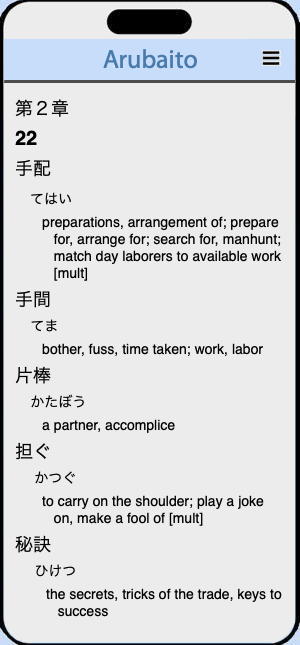
The wordbook has valuable features described below.
Features of the Wordbook
Page number
This is the page number of the original book.
It will be accurate only when the user has acquired the original book described by the listed ISBN.
Kanji entry
This is the form of the word as it appears in the original book.
Even so, the user must be ready to identify the kanji entry due to a variation. Verbs are presented in the citation form.
Many Japanese words can be adjusted by the writer to his or her preferred rendering. An example is the pair of renderings 思い切り and 思いきり, which indicate the same word. The wordbook may give former while the word actually appearing in the original book is latter.
Reading entry
This indicates the “reading” of the word (the phonetic syllables). The reading is usually given in hiragana, but katakana words may show the reading again in katakana.
The wordbook provides the reading on a separate line from both the kanji and the definition so that it can be quickly consulted. In some cases, the user will understand the definition of the original word but only needs to confirm the reading.
Definition entry
This is an English language explanation of the meaning of the word.
These definitions have been carefully crafted to facilitate understanding of modern Japanese with use of modern English.
Some definitions include helpful extra remarks, such as pointing out that the same kanji word can have another reading as well as the principal reading. For example, 辺り has the reading entry あたり, but the definition explains that it can also be read ほとり .
In addition, the definition entry may include one, two, or all three of a possible extra notation, as follows.
[mult] indicates that the word has “multiple meanings”. In such a case, the various meanings are usually quite distinct, and therefore the reader must consider which meaning applies to the passage in the original book.
[hom] indicates a “homonym”. It can be important to understand that a common word heard in one situation can be different from the same sounding word heard in another situation. This explanation intentionally emphasizes “heard” rather than “read” because the kanji renderings of the homonyms will be different.
[hira] indicates “hiragana” and refers to words that usually appear in hiragana rather than kanji even though a kanji rendering exists. In this way, the reader can be aware of customary usage while remaining prepared to encounter the word in a non-customary form.
Be Ready to Use a Dictionary
While the wordbook will provide many words that the user may find helpful, it does not contain an entry for every single word in the original book.
The user will most likely come across an unfamiliar word and notice that the word is not contained in the wordbook.
In preparation for this case, the user should have a dictionary and check it when needed. Doing so can greatly aid the user in gaining an understanding of the content in the original book.
Many display devices can run the Blue Sea Wordbook and a dictionary at the same time. Tablets can allow the user to split the screen and keep the Blue Sea Wordbook on one side and the dictionary on the other side. This enables quick checking of original book unfamiliar words.
It may be a good idea to adjust settings on the display device so that it does not automatically turn off at short intervals and so that the dictionary and wordbook are shown with dark mode, which will prolong battery life.
Rereading the Original Book
The reader will benefit from the very helpful practice of rereading the original book at a later date.
At a second reading of the book, listed words will already be highlighted, reducing the time and effort needed. The story will not be as fresh as one experienced for the first time, but familiarity with the content will allow the reader to proceed through the sentences with a more natural flow, reinforcing the language.
Using the Wordbook with a Different Version of the Original Book
The wordbook lists the page numbers of the original book described by the ISBN at the linked information page above and in the appendix of the book.
The wordbook can be used with other versions of the original book but the page numbers given in the wordbook will not match the page numbers in the original book.
However, the chapters of the wordbook will still match the chapters of the original book for any version of the original book. Therefore, the table of contents of the wordbook can still be used to locate a corresponding place in the original book.
The wordbook presents entries in word-after-word order, so the user can locate a needed definition by examining the sequence of entries in the wordbook.
Beyond that, a user may find it helpful to use the bookmark function of the reader app that displays the wordbook in order to keep track of a location corresponding to one in the original book.
Learning Kanji
The reader may already be familiar with kanji. If so, that is a great advantage. However, many people learning Japanese as a second language will find kanji to be a hurdle.
Blue Sea Press offers “Kanji Learning Today” as an excellent system for learning kanji.
The system has two modes, a paper workbook and an online interface. The two modes complement each other, presenting the kanji in the same sequence while providing a slightly different learning experience.
See Kanji Learning Today for more information.
Accent
Another hurdle in the Japanese language is proper pronunciation.
Most dictionaries do not show accent marks for their word entries. Furthermore, the accent explanations many in textbooks are difficult to apply.
Blue Sea Press offers “Japanese Accent: Penult Standard” as a system for easily and comprehensively understanding accent.
See Japanese Accent for additional information.
The Whole Package
When the user has gained some mastery of all three hurdles — kanji, accent, and reading — he or she will be ready for great reading experiences that improve Japanese language ability.
The Blue Sea Wordbook is a tool for assisting the reading component.
Blue Sea Tips
Blue Sea Press also offers tips that may help learners to become more proficient at Nihongo (the Japanese language).

See Blue Sea Tips for additional information.
Other Information
See Other Information for details about Blue Sea Press.