BSP


Irainin
Blue Sea Wordbook
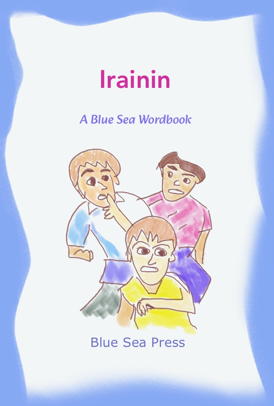
About Irainin
“Irainin” is a Blue Sea Wordbook for the original Japanese book ふゆかいな依頼人, which is described in detail below.
Bibliographic data for the Blue Sea Wordbook “Irainin” is as follows.
Many mid-level and upper-level vocabulary entries are given. Low level vocabulary may be excluded.
Most adverbs are excluded.
The Blue Sea Wordbook “Irainin” is available in the Shopping Cart.
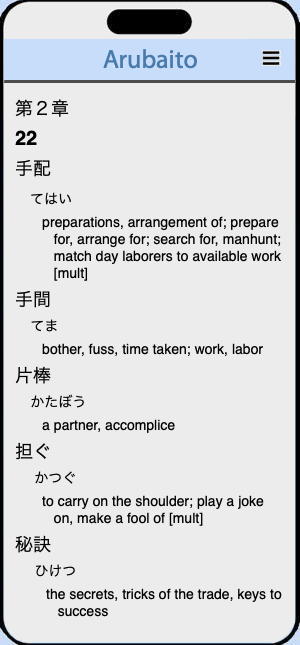
Wordbook Format
The wordbook is an eBook (epub) that can be opened with a reader app. Typical eBook readers include the Books app for iOS devices and the Google Play Books app on Android devices.
About the Original Japanese Book 「ふゆかいな依頼人」
The user must buy the corresponding original Japanese book separately.
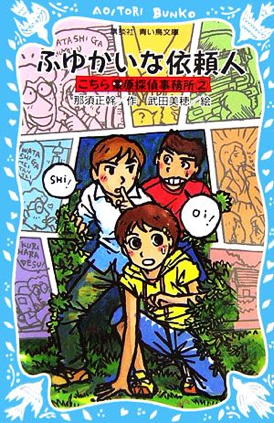
Bibliographic data for the original Japanese book is as follows.
The star rating is decided by Blue Sea Press based on the factors such as interest, literary quality, and suitability for a second language learner. To better understand why the rating was given, see the review below.
An older Japanese book may be available only as a used book. However, a popular Japanese book may have been reprinted or published in a different version.
For an explanation of how to use the wordbook with a different version of the original Japanese book, see the section on this topic at Blue Sea Wordbooks.
Review of the Original Japanese Book 「ふゆかいな依頼人」
The following review is by Todd Adkisson. He is also the editor of the Blue Sea Wordbook “Irainin”.
Genre
This is an adolescent mystery. The author, Masamoto Nasu, wrote almost exclusively for young readers. We are lucky that he did, because he was a terrific writer.
Level
Written for adolescents, the vocabulary is in line with literacy for this age group. That said, it should be noted that Nasu started writing in the late 1970s and it can be argued that expectations for literacy were a little higher then. The book is very suitable for beginning Nihongo second language learners, but there will be challenges.
Synopsis
The father of a four-person family has a small private investigator practice. His two daughters and their friends often help with a case.
An middle-aged gentleman comes in with a request to find his niece, who has disappeared. The man manages a large family business, and the niece is expected to inherit the company in the near future.
The father and daughters take separate approaches to track down information. Eventually they find the young woman and uncover some uncomfortable details about the inheritance.
Style
As mentioned above, Nasu is a great writer. His books are always interesting, even though his target audience is adolescent readers. The challenges have to do with language. Nasu does not cut corners with colloquial speech or unusual vocabulary. You have to keep up.
This actually turns out to be great practice for NSL learners because the reader gets plenty of exposure to informal Nihongo, and such exposure can be lacking in the environment around a new language learner.
An extra note regards the illustrations. Nasu regularly partnered with a single illustrator for many of his books. For many years that artist was Kazuo Maekawa. His illustrations were a great complement for Nasu’s storytelling. In this book, the illustrator is Miho Takeda, and she continues the tradition of adding great images alongside Nasu’s story.
Using the Blue Sea Wordbook
For a detailed explanation of how to use the wordbook, see Blue Sea Wordbooks.

Go to Blue Sea Wordbooks.